

Yo, what's up everyone! I'm a supplier of the 16 Cavity Oil Cap Mould, and today I wanna chat about the shrinkage rate of the oil caps produced by this awesome mould.
First off, let's talk about what shrinkage rate actually means. When we're making oil caps using a mould like our 16 Cavity Oil Cap Mould, the plastic material cools down and solidifies after being injected into the mould cavities. As it cools, it naturally shrinks a bit in size. The shrinkage rate is the percentage of this size reduction compared to the original size of the plastic in the molten state.
Now, the shrinkage rate can vary depending on a bunch of factors. One of the main ones is the type of plastic we're using. Different plastics have different shrinkage properties. For example, polypropylene (PP), which is a commonly used material for oil caps, usually has a shrinkage rate in the range of 1.0% - 2.5%. However, for high - density polyethylene (HDPE), the shrinkage rate might be a bit different, typically around 1.5% - 3.0%.
The design of the 16 Cavity Oil Cap Mould itself also plays a big role. The thickness of the oil cap walls matters a lot. Thicker walls generally lead to more shrinkage because there's more plastic mass that needs to cool and contract. If the walls of the oil cap are uneven in thickness, it can cause uneven shrinkage, which might result in warping or distortion of the final product.
The processing conditions during the injection molding process are super important too. The temperature of the plastic melt, the injection pressure, and the cooling time all have an impact on the shrinkage rate. If the melt temperature is too high, the plastic will flow more easily but might also have a higher shrinkage rate when it cools. On the other hand, if the injection pressure is too low, the plastic might not fill the mould cavities properly, leading to incomplete parts and inconsistent shrinkage.
Let's say we have a scenario where we're using our 16 Cavity Oil Cap Mould to produce oil caps from PP. To get a more accurate shrinkage rate, we need to do some testing. We can produce a batch of oil caps and measure them carefully. We measure the critical dimensions, like the diameter, height, and wall thickness, right after they come out of the mould and then again after they've fully cooled and stabilized.
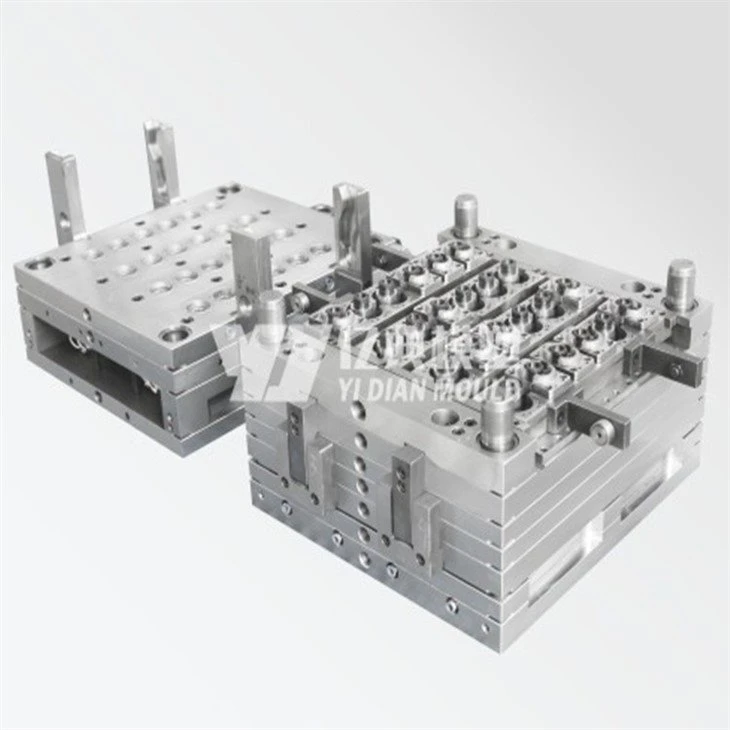

After multiple test runs and measurements, we might find that for this particular combination of material (PP) and our 16 Cavity Oil Cap Mould, the average shrinkage rate for the overall size of the oil cap is around 1.8%. This is just an example value, and in real - world applications, it could be different depending on all those factors I mentioned earlier.
Now, why is it so important to know the shrinkage rate? Well, if we don't have a good handle on it, the oil caps we produce might not fit properly on the oil containers. A cap that's too big won't seal tightly, which can lead to oil leakage. And a cap that's too small won't even fit on the container. So, having an accurate understanding of the shrinkage rate allows us to design the 16 Cavity Oil Cap Mould with the right dimensions. We can slightly oversize the mould cavities to account for the shrinkage, so that the final oil caps have the exact dimensions we need.
Our 16 Cavity Oil Cap Mould is designed with high precision to minimize any variations in the shrinkage rate across the 16 cavities. But if you're looking for a different cavity configuration, we also have the 24 Cavities Cooking Oil Cap Mould, which can produce more oil caps in one cycle. And for those who are in the edible oil industry, our Edible Oil Cap Mould is a great option. It's designed to meet the specific requirements for caps used on edible oil containers.
If you're in the business of producing oil caps and are looking for a reliable mould, our 16 Cavity Oil Cap Mould might just be what you need. We've spent years perfecting our mould designs to ensure high - quality, consistent oil caps with an accurately predicted shrinkage rate.
So, if you're interested in learning more or want to start a procurement negotiation, don't hesitate to reach out. We're here to help you get the best mould for your oil cap production needs.
References
- Injection Molding Handbook, by O. Olajide
- Plastics Processing Technology, by John Doe


